

There is a reason this comparison refuses to fade. The Toyota Camry and the Honda Accord sit at the center of the midsize sedan market, not through noise or novelty, but through consistency. Year after year, each refines its purpose.
Exterior Form and Interior Comfort Execution
The Camry presents a more expressive design. The front fascia carries sharper definition, and the body lines feel deliberate rather than restrained. It gives the car a sense of motion even when parked.
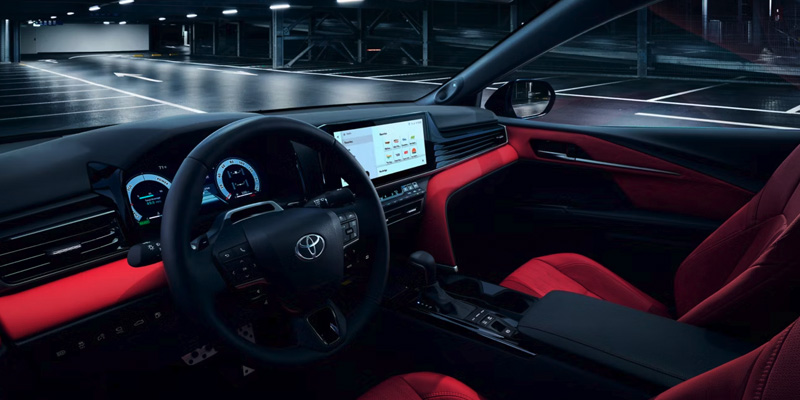
Inside, the Camry balances space with finish. Cargo capacity reaches 15.1 cu. ft., and the seating position feels natural for longer drives. Materials improve as you move up the range, with available leather-trimmed seating adding a more refined tone. The cabin remains quiet at speed, which becomes noticeable over time.
The Accord takes a more reserved approach. Its design is clean and straightforward. The interior is spacious, with strong rear legroom, though the material quality and isolation do not reach quite the same level as the Camry.
Engine Output and Efficiency Balance
The Camry offers a 2.5L engine producing 203 hp and 184 lbs. ft. of torque in current configurations, paired with a smooth-shifting transmission that favors consistency over urgency. Hybrid variants expand efficiency without changing the driving character.
The Accord begins with a 1.5L Turbocharged engine producing 192 hp. It delivers solid efficiency and steady performance. Previous higher-output options gave it a stronger edge at outright speed, though recent focus has shifted toward balanced efficiency.
In daily driving, the Camry feels more composed under acceleration. Power delivery is predictable. The Accord feels lighter in response, though less substantial at higher speeds.
Safety Systems and Standard Feature Coverage
Toyota equips the Camry with Toyota Safety Sense™ 2.5+, a suite that includes Pre-Collision System with Pedestrian Detection, Lane Departure Alert with Steering Assist, and Full-Speed Range Dynamic Radar Cruise Control. These features are standard across the lineup.
Honda includes Honda Sensing® on the Accord, offering Collision Mitigation Braking System and Road Departure Mitigation. The coverage is strong, though Toyota’s standardization across trims gives the Camry a more consistent baseline.
Infotainment Design and Connectivity Layout
The Camry integrates an 8-inch Toyota Audio Multimedia display as standard, with an available 12.3-inch upgrade. Apple CarPlay® and Android Auto™ are included, along with available features like Wi-Fi Connect and Remote Connect. The interface responds quickly and remains easy to navigate.
The Accord also supports Apple CarPlay® and Android Auto™, though the interface leans toward simplicity rather than depth. It works, but it lacks the layered functionality found in the Camry’s higher trims.
Ownership Experience and Daily Usability
Over time, the Camry leans toward refinement. Ride quality remains controlled. Cabin noise stays low. Controls feel consistent across different driving conditions. It is a car that settles into routine without demanding attention.
The Accord focuses on practicality. It offers strong space and straightforward operation, though it does not carry the same sense of polish in materials or isolation.
Visit Ardmore Toyota in Ardmore, PA
The differences between these two sedans become clearer when you spend time inside them. Visit Ardmore Toyota and experience the Camry in person. The details that define the drive tend to stand out once you are behind the wheel.
Connect with us


Recent Blog Entries
- 2026 Toyota Highlander vs. Honda Pilot vs. Kia Telluride: Which Three-Row SUV Is Built to Last?
- Ardmore Toyota Proudly Supports the Annual Ardmore Bike Race
- Ardmore Toyota Supports Community Connections at National Night Out
- Is Toyota Reliable? What Owners and Shoppers Should Expect Long-Term
- Common Toyota Troubleshooting Problems: What Drivers Experience and How to Fix Them